
Seawall and Dock Inspection in Naples, FL: What a Home Inspector Can and Can't Tell You
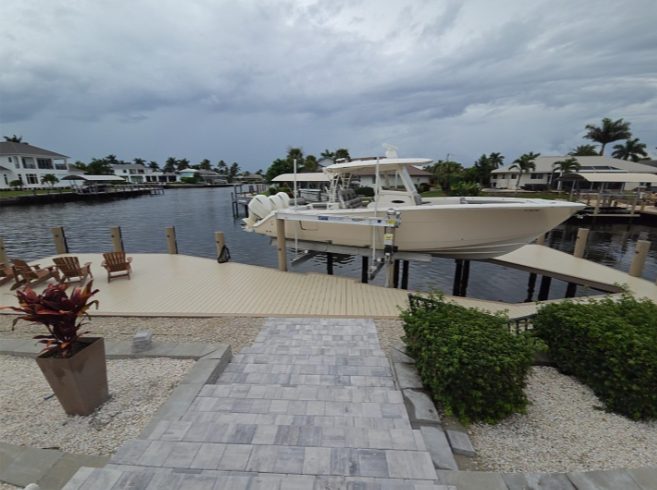
If you are buying a canal or bay home in Naples, Marco Island or Bonita Springs, there is a structure on the property that most buyers never think about until the week before closing, and it may be the most expensive thing on the lot after the house itself. The seawall is holding your yard out of the water, and the dock and lift are hanging off it. On a Port Royal or Aqualane Shores lot the wall can be the better part of a hundred feet long, and Florida seawall cost guides put full replacement on a saltwater canal at $250 to more than $1,200 per linear foot once demolition, permitting and backfill are counted, which on a hundred feet of wall is a number with five digits in it before the dock is touched. A buyer who closes without anyone having looked at the wall is buying it blind.
Here is something most buyers do not know. The majority of home inspection companies will not look at the seawall or the dock at all. They are outside the standards of practice, they sit at the edge of the property, and an inspector without a construction background has no business forming an opinion on them, so most do not. We do. Patriot Home Inspections trains and oversees its inspectors under a program run by a licensed general contractor, and that background is the reason we are willing to put eyes on a wall and tell you what we see. What we provide is a review of the seawall, the dock and the lift as part of every waterfront home inspection. Our reports say it plainly: boat docks and seawalls are outside the scope of the inspection, and the observations are general ones provided to assist with the overall evaluation of the property, with further evaluation recommended. It is not a detailed or engineered inspection, but it guides you. It tells you whether the money for a specialist is money well spent, and on a Naples canal lot that is a question worth answering before the contingency runs out.
The cast net and the spear gun
The way we explain it on site is this. Our seawall and dock review is a cast net. It covers the area, it brings up the obvious and the not so obvious, and it tells you whether there is something down there worth a closer look. A marine contractor's evaluation is a spear gun. It is precise, it is instrumented, and it is the only thing that should decide whether a wall is sound. The net tells you where to aim before you commit to the spear, and on a lot where the wall could cost more than a car to repair, knowing where to aim is worth a great deal.
That is why we always recommend further evaluation by a dock and seawall specialist on waterfront purchases. We say it in the report whether we found something or not, because the limits of our vantage point are real and we would rather be plain about them than let a buyer believe a visual review from the yard is the whole story.
What we look at on the seawall
A seawall gives up its secrets slowly and mostly from the land side, which is where we can stand. We walk the full length of the cap and look for cracks in the wall and in the cap itself, and we pay attention to whether a crack is a hairline in old concrete or a separation that lines up with a panel joint, because the second one is telling you the panels are moving. We look for erosion at the wall, which shows up as soil loss along the cap, sinking or sunken spots in the lawn a few feet back from the edge, voids under pavers, and a lawn that slopes toward the wall when it should slope away. Soil disappearing behind a seawall means water is moving through it, and water moving through a seawall is the beginning of every seawall failure we have ever seen.
We look for signs of blocked or lacking drainage. A seawall is supposed to let groundwater out through weep holes so that pressure never builds behind the panels, and on a lot of older walls in the City of Naples those weeps are clogged, buried or were never there. We look for damage and erosion to the wall face where we can see it at low tide, including spalling concrete, exposed rebar rusting in salt air, and the staining that tells you the wall has been wet on the wrong side. 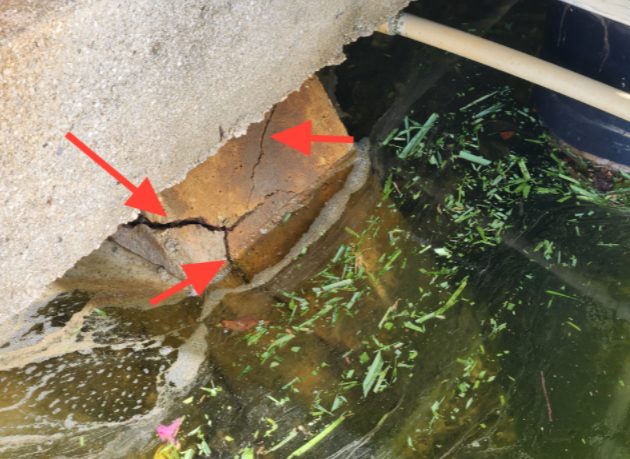
The photo above is what a cap failure looks like from the dock side on a Naples canal lot. The cap has separated from the panel below it, the concrete is spalling into the water and the arrows mark three cracks that line up, which is how you know the panel is moving rather than the surface weathering. That is a finding that leaves our report with a recommendation for a marine contractor before closing.
We note whether the wall leans. A wall that is out of plumb toward the canal is under pressure it was not designed to carry, and that is a finding that goes straight to the top of the report with a recommendation for a specialist before you close.
On Marco Island we add one more item to the list, and it is one you will not find in any inspection textbook. The green iguanas that have taken over the island dig burrows, and they like to dig them along seawalls where the soil is soft and the sun is warm. Those burrows run back under the cap and behind the panels, and over a few seasons they do the same thing a failed weep hole does, which is let water move soil out from behind the wall. On a Marco canal lot we look for burrow openings along the cap and in the lawn near it, and we count them as erosion at the wall, because that is what they become.
What we cannot see is anything under the waterline, the condition of the tie-backs and deadmen buried in the yard, and the toe of the wall where scour does its work. No inspector standing on dry land can see those, including us, and anyone who tells you otherwise is guessing.
What we look at on the dock and the lift
The dock is more accessible and we treat it the way we treat any structure on the property. We check for damage, rot and corrosion in the decking, stringers, pilings and hardware, and we look for missing parts, which on a Naples dock usually means a bolt, a cleat, a cross brace or a section of fascia that salt and sun took years ago and nobody replaced. 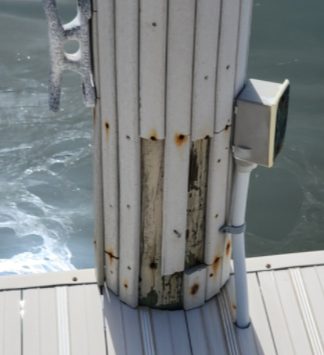
The piling wrap boards in the photo above are a Naples standard. They are cracked, the fasteners holding them are rusting through, and the board below the conduit has split along its length. None of it is dramatic on its own, and all of it goes in the report, because the fasteners are what keep the wrap on the piling and the wrap is what keeps the piling from being eaten.
We look closely at the electrical. Dock power is the one place on a waterfront property where a defect can be lethal rather than expensive, so we check that outlets are GFCI protected, that boxes and covers are rated for the location and intact, and that the wiring feeding the dock is not an extension cord someone buried a decade ago.
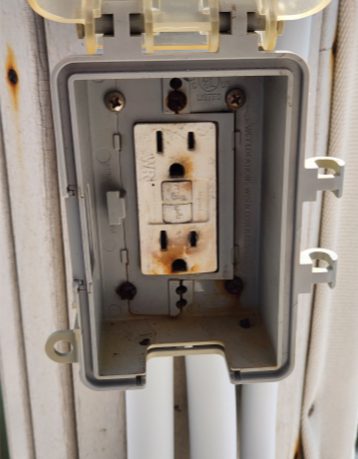
That outlet came out of a recent inspection on a canal lot here. It is GFCI protected, which is correct, and it has rust staining and scorch marks on the face, which is not. An outlet that has arced in a salt environment a few feet from the water gets written up as a defect with a recommendation for an electrician, and it is the kind of item a buyer never sees because it lives behind a cover on the far side of a piling.
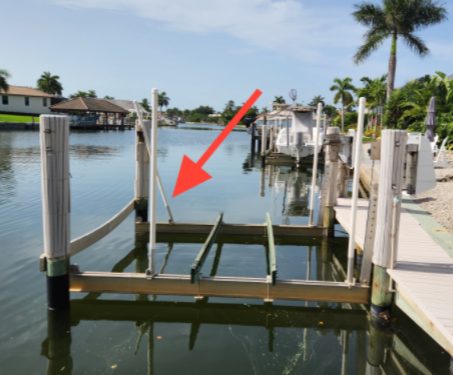
The lift gets a quick operational test. We run it up and down and we watch it move. We are confirming that it functions, that the motor runs, that the cables wind evenly and that nothing binds or grinds. That is a general review and not a detailed evaluation of the lift, and we say so. If it does not run, or it runs badly, that is a line item for a lift company before closing, and on a lift sized for a thirty-foot boat that is not a small line item.
What a real dock finding looks like
So that this is not abstract, here is the dock section from a recent Patriot report on a Naples canal home, with the address removed. The items that did not function or were defective at the time of inspection were the dock light fixtures, multiple wood piling wrap boards that were cracked and deteriorated, heavy corrosion on the fasteners securing those wrap boards, no water at the hose bibs at the dock, one cracked dock piling, one exterior GFCI outlet with rust staining and scorch marks, and multiple areas of exposed fastener rust. Seven items, photographed, in a section the buyer's previous inspector on a different house had not opened at all. None of them required a diver to find. All of them went into the negotiation.
Why the vantage point limits everyone
Water and vantage point are the two things that limit any seawall review. Tide decides how much of the wall face you can see on a given morning. The yard side of a wall hides the anchors that hold it up. The canal side hides the toe. There is no substitute for a diver and a probe, which is why the engineered evaluation exists as a separate service. We would rather tell you that plainly than pretend our visual pass is a certification.
What our review does do is put a trained eye on the structure. Every Patriot inspector works under a training program and oversight run by our owner, who holds Florida general contractor and roofing contractor licenses, and the seawall and dock review is part of that program. A seawall is under forces that nothing else on the property sees, tide on one side and saturated soil on the other, so we treat it as its own structure and report it as its own item rather than folding it in with the pool deck or the driveway.
When to bring in the specialist
Our advice to clients is simple. Do not buy a waterfront home in Naples, Marco Island, Bonita Springs or Estero without a seawall and dock evaluation by a marine contractor or engineer. That is not negotiable in our book. The question is when, and the answer is that our review comes first. On the day of the home inspection you do not yet know whether you are buying this house. The roof, the electrical, the plumbing, the pool and the wall are all still open questions, and a specialist evaluation on a house you walk away from the next day is money spent for nothing. So start with our report. If the house checks out and the wall and dock look clean in our review, that is when you bring in the big guns, inside the contingency period, to confirm it before you close. If our review turns up erosion, cracking, drainage problems or a leaning wall, you know before you spend another dollar that the specialist is going to be the most important person in the deal, and their report becomes the document you negotiate with. On a Naples waterfront lot that negotiation can be worth more than the cost of both inspections many times over.
Questions buyers ask us about seawalls and docks
Do home inspectors check seawalls? Most do not. Seawalls and docks are outside the standards of practice for a home inspection, so the majority of companies skip them entirely. Patriot Home Inspections includes a general review of the seawall, dock and lift on every waterfront inspection in Naples, Marco Island, Bonita Springs and Estero, and recommends a specialist evaluation on top of it.
How much does a seawall inspection cost in Florida? A specialist seawall evaluation by a marine contractor or engineer is a separate service with its own fee, and it typically involves a diver and a physical probe of the wall. Our general seawall and dock review is included in the price of the home inspection at no added cost.
How often should a seawall be inspected? Marine contractors generally advise a professional look every few years on saltwater canals, and after any named storm. For a buyer, the answer is once before you close, and our review tells you how urgent that is.
What does a dock inspection include? In our review it covers the decking, stringers, pilings and wrap boards for damage, rot and corrosion, missing hardware, the dock electrical including GFCI protection, and a quick operational test of the boat lift.
What are the signs a seawall is failing? Cracks in the cap or along panel joints, soil loss or sunken spots in the lawn behind the wall, voids under pavers, clogged or missing weep holes, spalling concrete and exposed rebar, and any lean toward the water. On Marco Island, iguana burrows along the cap count too.
If you want to know what we see on waterfront properties here, or you want the dock and seawall review included in a home inspection anywhere in Collier or Lee County, call us at (239) 826-5866 or schedule your inspection. We inspect the house, the pool, the roof and the water's edge, and we tell you where to aim the spear.